

Pain at the front of your hip is one of those things that’s easy to ignore until it isn’t. Maybe it’s a sharp grab when you sprint for a wave or kick a ball, or a dull ache at the front of your hip after a long run along the coast. Maybe it’s the stiff, pinchy feeling when you stand up after a day at the desk.
Hip flexor pain is common, and most of the time it settles well with the right plan. But “hip flexor pain” can mean a few different things, and a few conditions that feel very similar need different treatment. This guide from the Coogee Physio team covers where hip flexor pain is felt, what causes it, how long it takes to heal, the exercises that help, and how physio gets you back to running, surfing and training without it coming back.
What are the hip flexors?
Your hip flexors are the group of muscles at the front of your hip that lift your thigh towards your chest. You use them every time you walk, climb stairs, run, kick or pull your knees up on a surfboard.
The main players are:
- The big one. It’s actually two muscles, the psoas (which starts from your lower spine) and the iliacus (which starts from the inside of your pelvis). They join into one tendon that attaches to the top of your thigh bone.
- Rectus femoris. One of your quads. It’s unusual because it crosses both the hip and the knee, which is why it’s the hip flexor most often strained when sprinting or kicking.
- Smaller helpers, including sartorius and pectineus.
Where is hip flexor pain felt?
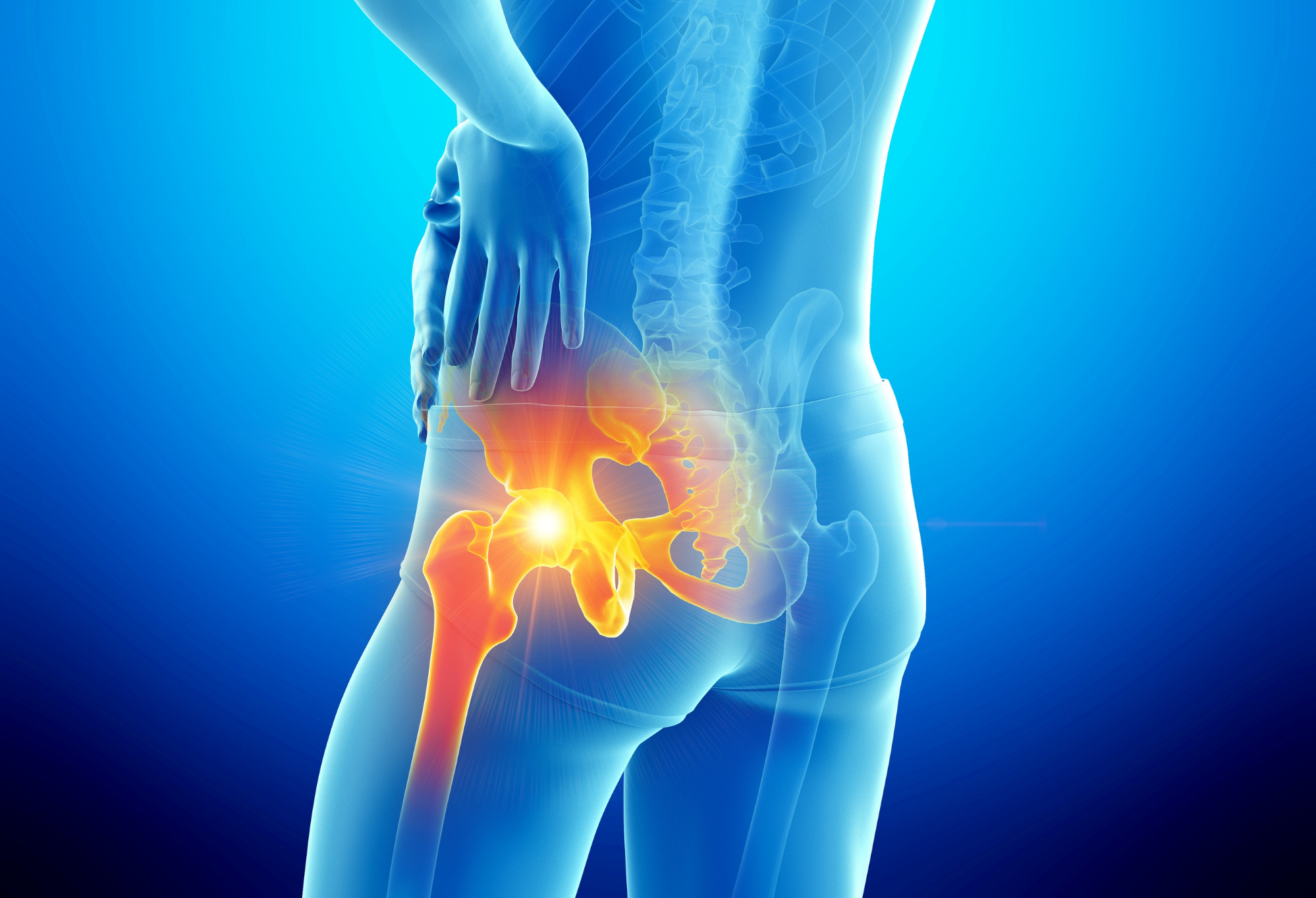
Hip flexor pain is usually felt:
- At the front of the hip, in the crease where your thigh meets your body
- In the groin, sometimes as a deep ache
- Down the front of the thigh, especially with rectus femoris strains
It’s often worse when you lift your knee, climb stairs, get out of a car, stand up after sitting, sprint or kick.
What causes hip flexor pain?
1. Hip flexor strain
A strain is a tear in the muscle fibres, from a few fibres to (rarely) a complete tear. It usually happens with a sudden, powerful movement: sprinting, kicking, changing direction quickly, or popping up on a surfboard. You might feel a sharp pull or “grab” at the front of your hip, followed by pain, tenderness, and sometimes bruising.
2. Hip flexor tendinopathy (often called tendonitis)
This is an overuse problem rather than a one-off injury. The iliopsoas tendon becomes irritated from repeated hip bending, and it builds up gradually. It’s common in runners, cyclists, kicking sports and dancers. It tends to ache with uphill running, getting up from a chair, or lifting your leg into the car.
3. A cork (contusion)
A direct knock to the front of the thigh or hip, like a knee in footy or touch, bruises the muscle rather than tearing it. It needs slightly different handling to a strain, which is one reason an assessment is worth it.
4. “Tight” hip flexors
Lots of people describe their hip flexors as tight, especially if they sit a lot. There is some research linking long hours of sitting with slightly less hip extension, but it hasn’t been shown that sitting causes hip flexor tightness or pain. Often what feels tight is actually a muscle that’s irritable, overworked or weak. That’s why stretching alone doesn’t always fix it.
Strain, tendinopathy or a cork? How they compare
| Strain | Tendinopathy | Cork (contusion) | |
| How it starts | Sudden pull or grab during a fast movement | Gradual build-up over weeks | Direct knock to the thigh or hip |
| Typical feeling | Sharp pain, then tenderness, sometimes bruising | Deep ache in the groin or front of hip | Bruised, sore, swollen spot |
| Common triggers | Sprinting, kicking, surfing pop-ups | Running, cycling, repeated hip bending | Contact sports |
| What helps | Protect early, then progressive loading | Load management and strengthening | Gentle movement and protecting from further knocks |
How long does a hip flexor strain take to heal?
Muscle strains are graded by how much of the muscle is torn. Healing time depends on the grade, which muscle is involved, and how well the rehab is managed.
| Grade | What it means | Typical recovery |
| Grade 1 | A small number of fibres torn. Sore, but strength and movement mostly OK | A few weeks |
| Grade 2 | A larger partial tear. Noticeable weakness and pain with movement | Several weeks, often a month or more |
| Grade 3 | A complete or near-complete tear. Major loss of function | Several months, sometimes needs a surgical opinion |
These are typical ranges, not promises. Most hip flexor strains heal within a few weeks. Injuries where the tendon itself is involved, rather than just the muscle belly, generally take longer. A review of rectus femoris injuries treated without surgery found return to sport averaged about a month for muscle injuries, but around four months when the tendon was involved (though the evidence is limited).
The bigger factor is how you return. Coming back on a timeline (“it’s been three weeks, I’ll go for a run”) is how strains recur. Coming back once you’ve hit clear milestones is how you stay back.
When it’s not your hip flexor
This is the part most hip flexor articles skip, and it’s the reason it’s worth getting front-of-hip pain properly assessed if it isn’t settling. Several conditions feel very similar:
- Hip joint problems, like femoroacetabular impingement (FAI), a labral tear or hip osteoarthritis. These often cause groin pain with deep squats, sitting for long periods or twisting.
- Referred pain from your lower back. Irritated nerves in the lower back can send pain to the front of the hip and thigh.
- Inguinal-related groin pain, sometimes called a “sports hernia”, and true hernias.
- Adductor (inner thigh) problems.
- Snapping hip, where a tendon flicks over bone with a clunk.
- Stress fracture of the femoral neck. Rare, but important for runners. More on this below.
Red flags: get it checked urgently
See a doctor or go to the emergency department if you have:
- Hip or groin pain and you can’t put weight on your leg
- Severe pain after a fall or injury
- A hot, swollen hip with fever or feeling unwell
- Numbness or tingling in the leg after an injury
And two specific ones we watch for:
- Runners with groin pain that’s worse with impact and building over time. This can be a femoral neck stress fracture, which needs prompt diagnosis (usually with an MRI). It’s more common in female distance runners and people who aren’t eating enough for their training load. Don’t run through it.
- Teenagers who feel a “crack” or sudden pain while sprinting or kicking. In growing bodies, the tendon can pull a small piece of bone away (an avulsion fracture). This needs an X-ray.
What to do in the first few days
If you’ve just strained your hip flexor, a good guide is the PEACE & LOVE approach from the British Journal of Sports Medicine:
- Protect it for the first one to three days. Avoid the movements that cause sharp pain, like sprinting, kicking and big stretches.
- Elevate and compress if there’s swelling or bruising.
- Avoid anti-inflammatories early on, as they may interfere with healing.
- Educate Understanding the injury helps you avoid doing too much or too little.
Then, after the first few days, LOVE:
- Load it gradually as pain allows
- A positive mindset is linked to better recovery
- Pain-free cardio, like walking or cycling, gets blood flowing
- Exercise to restore strength and movement. This is where a physio-guided plan matters most.
A freshly strained muscle also doesn’t want to be stretched hard, so leave the big stretches until it settles.
How physiotherapy treats hip flexor pain
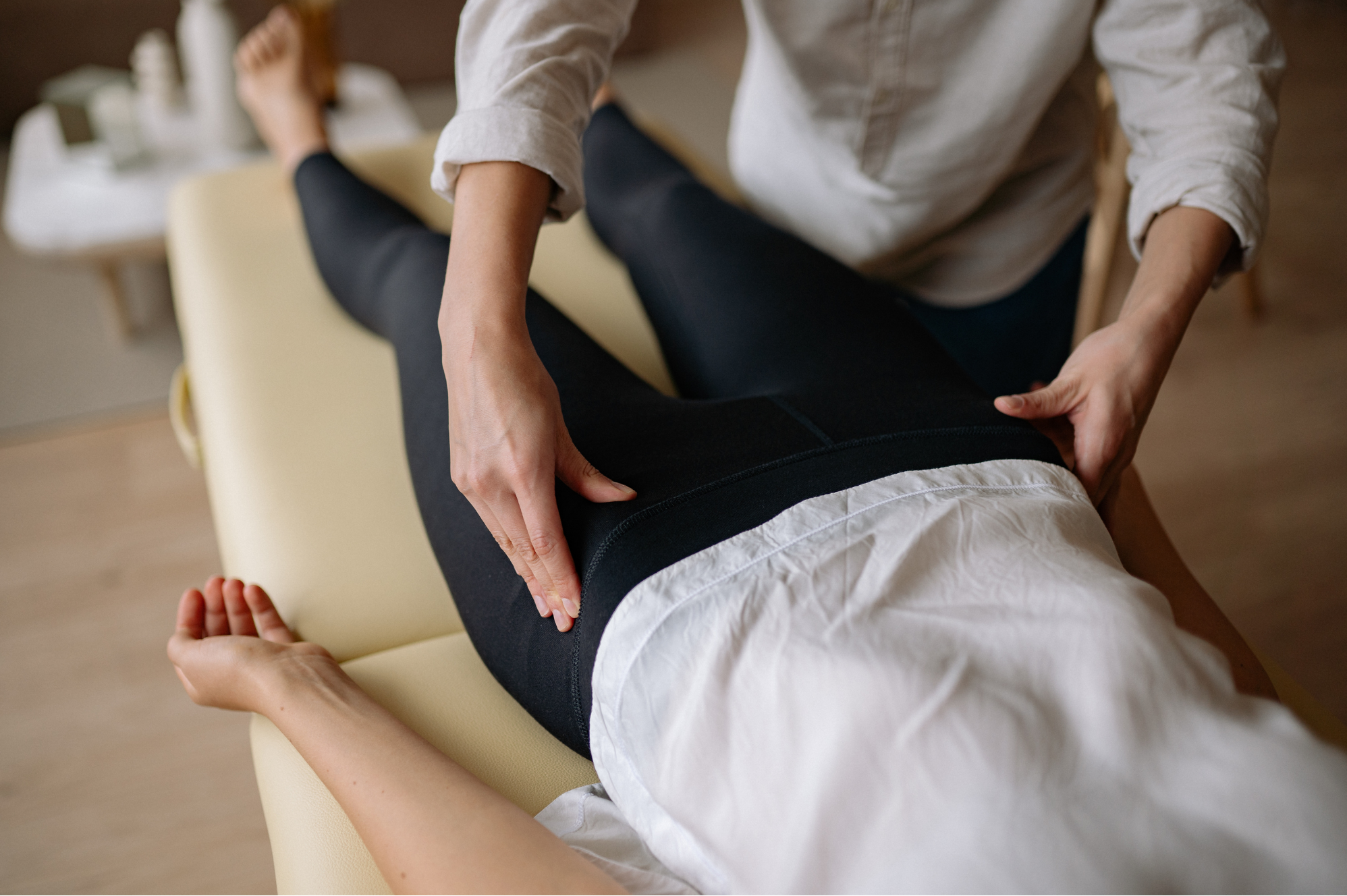
A proper assessment first
Your physio will work out which muscle or tendon is involved, how badly, and whether anything else is contributing. That usually means:
- Pressing on specific spots to find exactly where it’s sore
- Testing the strength of your hip flexors against resistance and comparing sides
- Checking your hip joint and lower back to rule out the look-alikes above
- Using tests like the modified Thomas test, where you lie back on the edge of the bed and let one leg hang. How the leg sits helps show whether the iliopsoas or rectus femoris is restricting your hip.
- For runners, looking at your running and training load. Our running assessment is built for this.
Progressive loading is the treatment
Research on groin injuries generally points to exercise as the main treatment, even though the studies aren’t perfect. Rest alone leaves the muscle weaker, which is a big reason hip flexor injuries come back. A good rehab plan builds strength gradually, through a progression roughly like this:
- Gentle holds (isometrics) to settle pain
- Strengthening through range
- Heavier and faster work
- Sport-specific movements like running, kicking or paddling and popping up
You move to the next stage when you’ve met the milestones for the current one, not because a certain number of days has passed.
Hands-on treatment as a support
Soft tissue work, joint mobilisation and dry needling can help ease pain and stiffness, especially in the early stages or with an irritable tendon. They make the exercise easier to do. They don’t replace it.
Hip flexor exercises a physio might give you
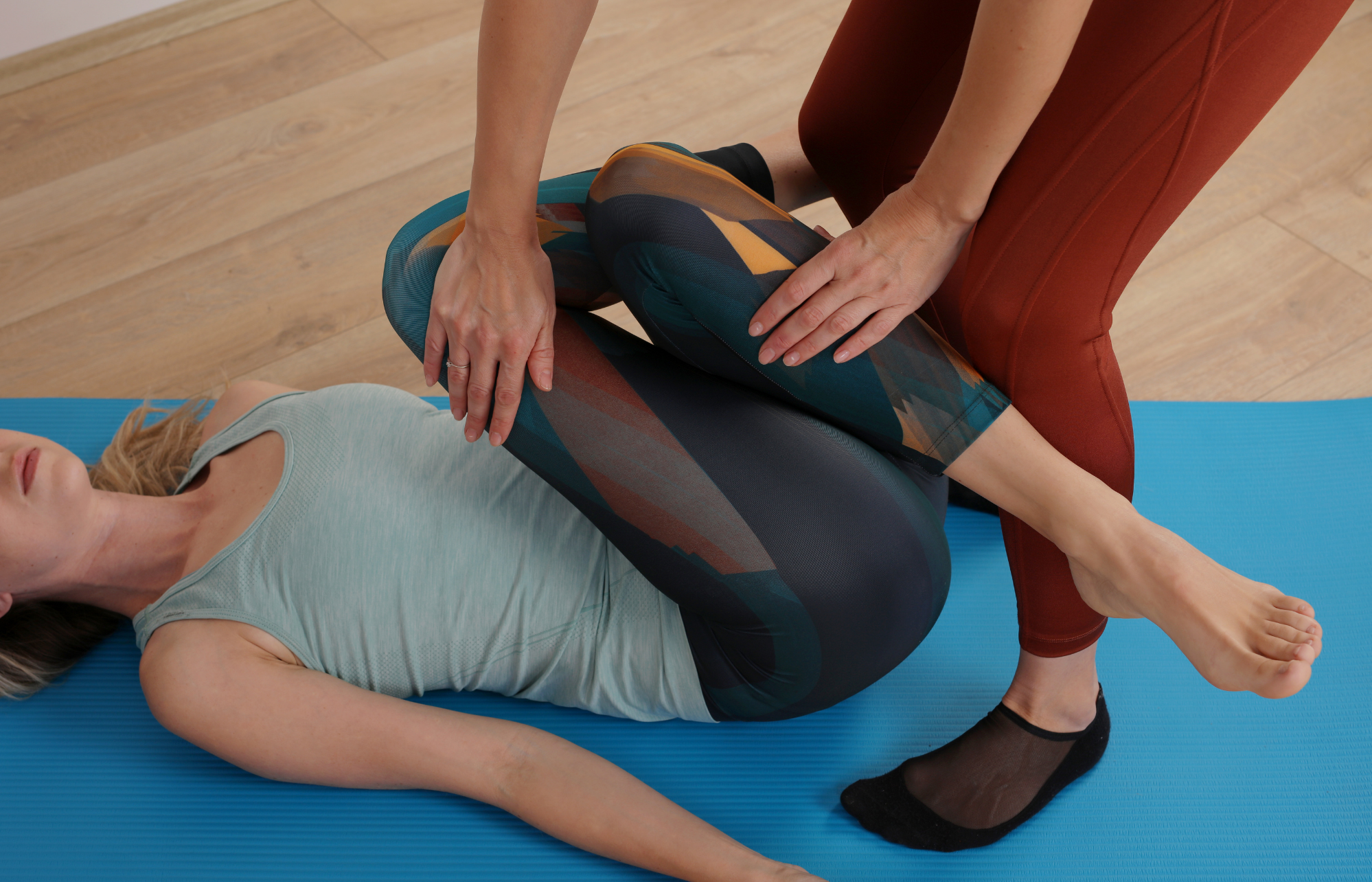
These are common starting points. Your physio will choose and adjust them based on what they find, so treat this as a guide rather than a program. Stop any exercise that causes sharp pain.
Early stage (settling things down)
- Pelvic tilt with marching. Lie on your back, knees bent. Gently flatten your lower back to the floor, then slowly lift one foot a few centimetres and lower it. Alternate legs, 8 to 12 per side.
- Isometric hip flexion. Sit on a chair and press your knee up into your hand without letting it move. Hold for 20 to 30 seconds, 4 to 5 times, at an effort that feels comfortable.
- Glute bridges. Strong glutes share the load around the hip. 2 to 3 sets of 10 to 12.
Middle stage (building strength)
- Standing banded hip flexion. With a resistance band around your ankle, lift your knee towards your chest slowly and lower with control.
- Step-ups. Start with a low step and build height.
- Kneeling hip flexor stretch (once the strain has settled). Kneel on one knee, tuck your tailbone under and gently shift your weight forward until you feel a stretch at the front of the hip. Hold 15 to 30 seconds, 2 to 4 times.
Late stage (getting back to sport)
- Walking lunges and split squats
- Faster knee drives, then running drills
- Sport-specific work: graded running, kicking, or paddling and pop-up practice for surfers
Hip flexor pain and running, surfing and the gym

Around Coogee, we see hip flexor pain in a few familiar patterns:
- Runners who ramp up kilometres quickly, add hills or the coastal walk stairs, or switch between road and soft sand. Hip flexor pain can appear alongside other overuse injuries like runner’s knee and shin splints, which usually points to a training load issue.
- Surfers, where the explosive pop-up and long paddles both load the front of the hip.
- Ocean swimmers who kick hard, especially when they jump up their training for a race season.
- Gym-goers doing high-volume leg raises, sprints or sled work without building up to it.
The common thread is load jumping faster than the tissue can adapt. The fix is rarely “stop completely”. It’s usually “adjust the load, build strength, then progress back”.
When can you run again?
A good general guide is that you’re ready to return to running when:
- Walking, stairs and getting in and out of the car are pain-free
- You have full, pain-free hip movement
- Your hip flexor strength is close to the other side (physios often aim for over 90%)
- You can hop and do fast knee drives without pain
Then build back gradually, starting with short, easy runs on flat ground.
When to see a physio for hip flexor pain

Book an assessment if:
- The pain hasn’t improved after a week or two
- It keeps coming back every time you increase training
- You felt a pop or sharp grab and now have weakness
- You’re not sure whether it’s your hip flexor or something else
- You want a clear plan to get back to running, surfing or training
Frequently asked questions
Where is hip flexor pain felt? Usually at the front of the hip, in the crease where your thigh meets your body, and sometimes deep in the groin or down the front of the thigh. It tends to be worse when lifting your knee, climbing stairs or standing up after sitting.
How long does a hip flexor strain take to heal? Most mild strains heal within a few weeks. Moderate strains usually take several weeks, often a month or more. Injuries involving the tendon or a complete tear take longer. Returning based on milestones rather than time gives you the best chance of it not coming back.
Should I stretch a strained hip flexor? Not hard, and not in the first few days. Early on, gentle movement and strengthening are better. Stretching can be added once the pain has settled.
How do I strengthen my hip flexors? Start with gentle holds and marching exercises, then progress to banded hip flexion, step-ups and lunges. The right starting point depends on how irritable your hip is, so it’s worth getting a plan from a physio.
Can I keep running with hip flexor pain? If it’s a mild ache that settles quickly and isn’t getting worse, you may be able to keep running with less load. If the pain is sharp, makes you limp, or is building over time, stop and get it assessed. Groin pain in runners that worsens with impact needs to be checked for a stress fracture.
Is sitting all day making my hip flexors tight? It might contribute, but the evidence is weaker than most people think. Often what feels “tight” is a muscle that’s irritable or weak. Getting up and moving regularly, plus strengthening, usually helps more than stretching alone.
The bottom line
Most hip flexor pain settles well with the right plan. The key is working out exactly what’s going on, protecting it early, then building strength back step by step so you return stronger, not just pain-free.
If you’ve got pain at the front of your hip and you’re anywhere around Coogee, Randwick, Clovelly, Maroubra or the Eastern Beaches, book an assessment with the Coogee Physio team. We’ll work out what’s going on and help you get back to doing what you love.
Written by Nadine Judelman, physiotherapist and clinic owner, Coogee Physio. This article is general information, not a diagnosis. For advice about your situation, book an assessment or speak with your GP. If you can’t put weight on your leg or have severe pain after an injury, seek urgent medical care.
References
- Cleveland Clinic, Hip flexor strain. https://my.clevelandclinic.org/health/diseases/23978-hip-flexor-strain
- Bordoni B, Varacallo M. Anatomy, Bony Pelvis and Lower Limb: Iliopsoas Muscle. StatPearls. https://www.ncbi.nlm.nih.gov/books/NBK531508/
- Healthdirect Australia, Hip pain. https://www.healthdirect.gov.au/hip-pain
- Physiopedia, Iliopsoas tendinopathy. https://www.physio-pedia.com/Iliopsoas_Tendinopathy
- Physiopedia, Muscle strain. https://www.physio-pedia.com/Muscle_Strain
- Physiopedia, Thomas test. https://www.physio-pedia.com/Thomas_Test
- Weir A, et al. Doha agreement meeting on terminology and definitions in groin pain in athletes. British Journal of Sports Medicine 2015. https://wrap.warwick.ac.uk/104765
- Griffin DR, et al. The Warwick Agreement on femoroacetabular impingement syndrome. British Journal of Sports Medicine 2016. https://bjsm.bmj.com/content/50/19/1169.full
- Boukabache A, Preece SJ, Brookes N. Prolonged sitting and physical inactivity are associated with limited hip extension. Musculoskeletal Science and Practice 2021. https://salford-repository.worktribe.com/output/1350494
- Bogwasi LM, et al. Proximal rectus femoris injuries: a systematic review. Biology of Sport 2023. https://repository.up.ac.za/items/f6a8c60c-f4ca-4d69-8521-81da2deb6b01
- Dubois B, Esculier JF. Soft-tissue injuries simply need PEACE and LOVE. British Journal of Sports Medicine 2020. https://bjsm.bmj.com/content/early/2019/08/03/bjsports-2019-101253.abstract
- Charlton PC, et al. Exercise interventions for the prevention and treatment of groin pain and injury in athletes. Sports Medicine 2017. https://acuresearchbank.acu.edu.au/item/89541/exercise-interventions-for-the-prevention-and-treatment-of-groin-pain-and-injury-in-athletes-a-critical-and-systematic-review
- WikiMSK, Femoral neck stress fracture. https://wikimsk.org/wiki/Femoral_Neck_Stress_Fracture
- Royal Children’s Hospital Melbourne, Pelvic avulsion injuries. https://www.rch.org.au/clinicalguide/guideline_index/fractures/Pelvic_Avulsion_Injuries_%E2%80%93_Emergency_Department
- NHS, Hip pain in adults. https://www.nhs.uk/conditions/hip-pain/
Alberta Health Services, Hip flexor strain: rehab exercises. https://myhealth.alberta.ca/Health/aftercareinformation/pages/conditions.aspx?hwid=bo1616